

Getting the first fly out of the year ‘off the ground’ proved uncommonly difficult in 2017. Not for want of any enthusiasm or desire, you understand, but simply because the weather gods and the logistics fairies had obviously decided to get together and between them have a jolly good laugh at our expense.
We were to have gone to Gloucester and Oxford in March as the season opener. That got weathered off. Then we were due to go to see the historic V2 bunker in northern France in April. Another surplus of weather put paid to that though.
Never mind. For May we had a corker lined up: a visit to the Vulcan in its lair at Doncaster (or Finningley, as those of us who have been around too long still like to think of it). Unfortunately, a change of circumstances resulted in the Vulcan being dragged away and public access being withdrawn. A great pity, but we live in hope that the Vulcan’s exile is only temporary and that a replacement visit can be rescheduled in future.
We at the North Weald Flying Group are nothing if not resourceful though and so a similarly-themed excursion was quickly lined up in the Vulcan’s place. Permissions sought, invites extended, the logistics fairies were swiftly put in their place – all we needed now was reasonable weather on the day for the transit northwards…
Naturally, come the day in question, the country was neatly split in two, with the south being just about flyable, but the north being suitable only for the brave or stupid (or waterproof).
However, “we at the North Weald Flying Group are nothing if not resourceful” and in the time it takes to down a bacon butty the decision was made to take the planes over to Gloucester Airport (or Staverton, as those of us who have been around too long still like to think of it).
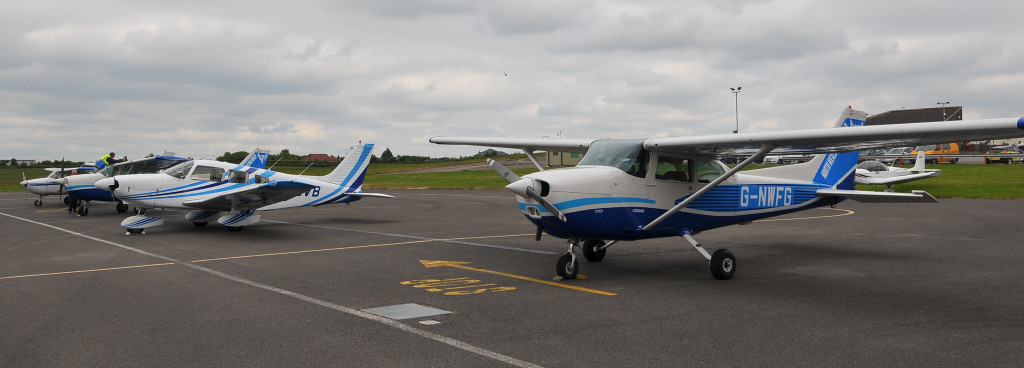
Despite all the shenanigans, we mustered together seven aeroplanes and crews – that’s five NWFG aircraft plus VB and G-GEEP.
For my part I was teamed up with my usual mount – Fox-Alpha – but crewed up with ‘new boy’ Sanjiv. This proved to be a very good pairing and was an excellent example of old meets new: me from the charts-and-plogs generation; Sanjiv from the iPhone and iPad generation. The first example of this difference coming as I in the left-hand seat taxied out and Sanjiv noticed the stopwatch on my kneepad. “What’s that for?” came the question. “I use it for timing if I need to fly a hold as part of an instrument approach” was my answer. “No, no. What’s it for??” Silly me – a generation is obviously growing up that’s never laid eyes on a stopwatch before – and why would you? If you need to time something you just use the timer function on your phone surely? Why go out and buy a separate (and antiquated) device!
Once airborne though, ‘old tech’ had reason to feel smug. ‘Battery issues’ meant that we swiftly lost the use of the various navigation devices that my co-pilot had brought along, meaning that my ‘Oh bless’ collection of hand-drawn lines on chats and old-fashioned time & heading calculations, allied to my tried-and-trusted Mk.1 Eyeball, came into their own.
The opportunity to debate the relative merits of our respective ‘tech’ aside, the outbound leg was fairly straightforward. Out via Bovingdon (navigated by dead-reckoning, but as usual I still made a point of spotting the VOR on the ground as we flew overhead), the only slightly iffy point was heading out via Princes Risborough where the gap between the top of the ridge and the bottom of the solid clag was j-u-s-t (we both breathed in as we passed though to be sure) 501 feet…
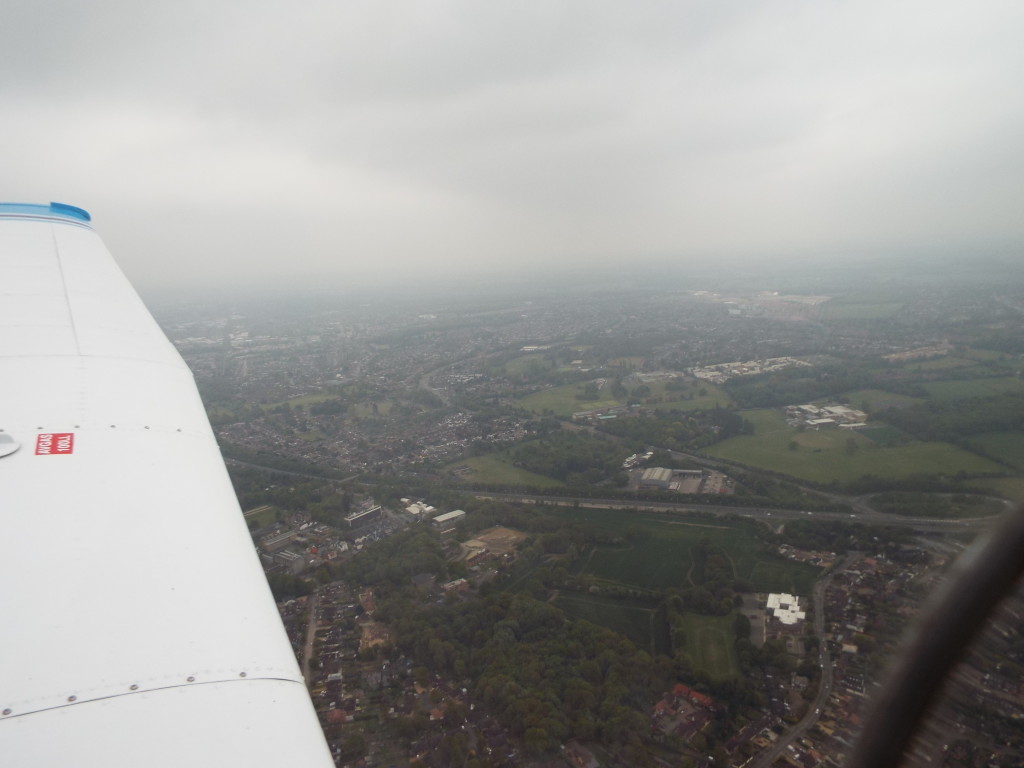
Fairly typical weather for a fly out…
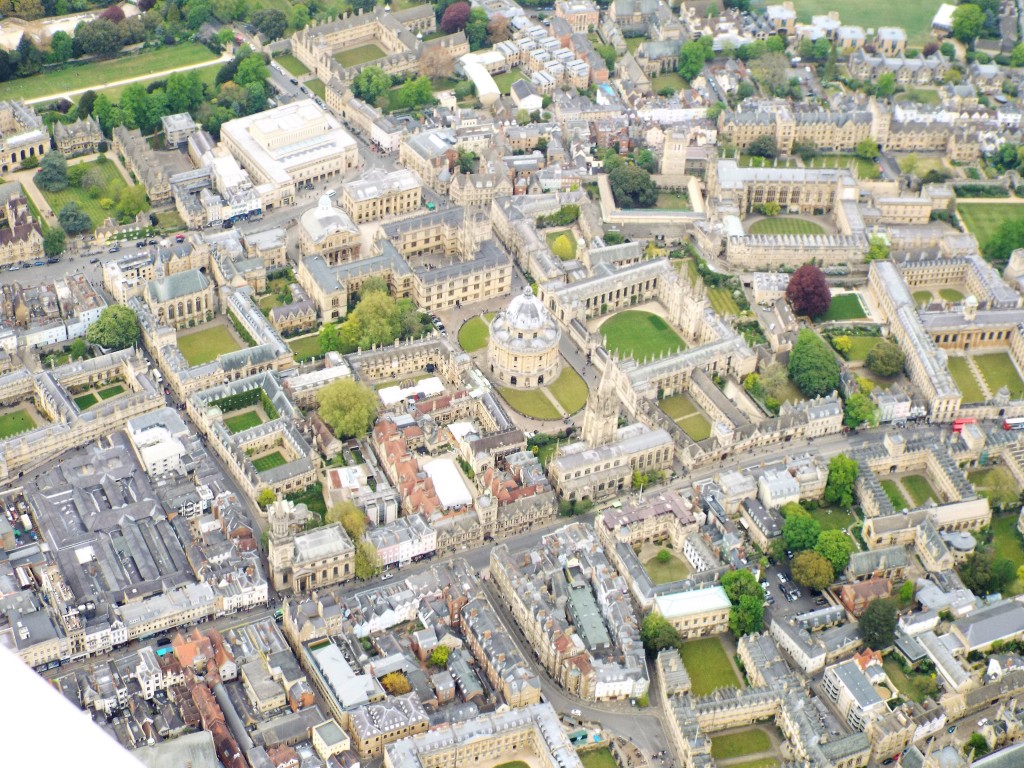
With the ground rapidly dropping away to the Oxfordshire levels beyond, we then had plenty of room to play with and the viz started to pick up to boot. Our route took us through Oxford Airport’s overhead (or Kidlington, as those of us who have been around too long still like to think of it) and then on for the most stupendous view of Blenheim Palace, which if I hadn’t been doing the tricky flying bit I would have loved to have taken a photo of to show you. Fortunately, VB’s crew made amends by getting an absolutely superb shot of the centre of Oxford instead:
The final ‘obstacle’ en route was the western Chilterns with spot heights of up to 1,000 feet, but fortunately, by this point, the cloud base no longer presented any difficulties. Of more interest was the way that the ground steeply drops back down as you pass over the final ridge, suddenly revealing all of Cheltenham laid out before you – quite spectacular!
Now came the odd part. Having crested the ridge at around 1,500 feet, Gloucester wanted us back up at 2,100 feet in order to commence a Standard Overhead Join procedure. With Runway 04 being in use with a left-hand circuit (i.e. circuits on the far side relative to the direction we were approaching from), this meant effectively having to give Fox-Alpha ‘full beans’ to scrabble as quickly as possible up to 2,100 feet, only then to have to chop the power and circle back down under the track we’d just flown along in order to lose 1,000 feet in time to join crosswind at circuit height. It worked, but it did all seem a bit ‘self-fulfilling’. Meanwhile, Pete and Vrai in NUKA concluded with some justification that as VFR traffic in receipt of a Basic service the SOH procedure was only a suggestion, so over-ruled it and requested (and had okayed) a direct crosswind join, thereby saving an awful lot of faffing around!
On the plus side, all that aerial manoeuvring over the top of Cheltenham afforded some splendid views of the racecourse and the GCHQ building. It also gave a good appreciation of all the lovely open countryside that surrounds Cheltenham, further making you wonder why that chap in the Cirrus some years ago elected to pop his BRS and float down into someone’s back garden, rather than land in one of the many open flat fields available…
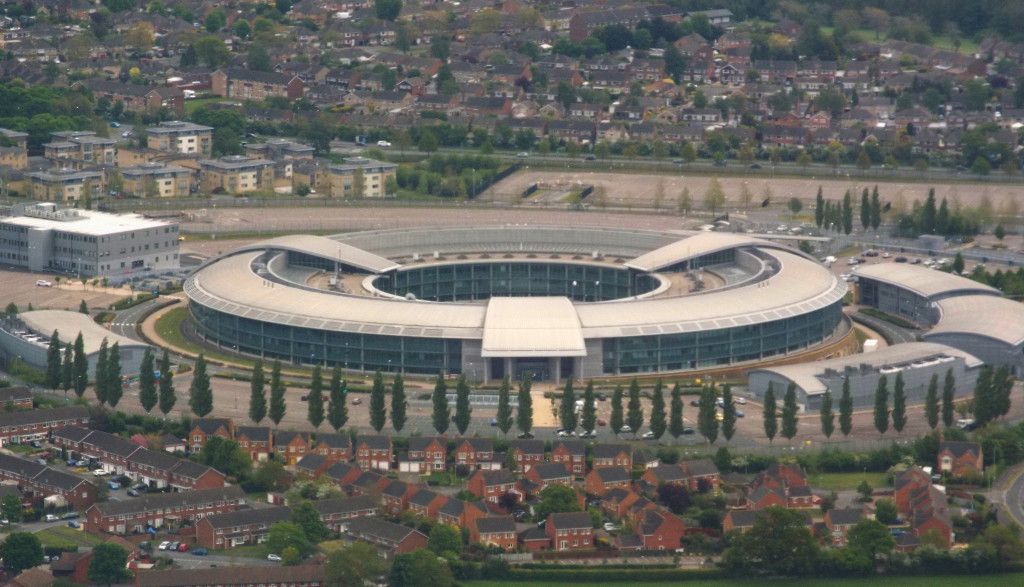
The giant tribute to the Electric Light Orchestra that is the GCHQ building
Back in the circuit at Gloucester and in Fox-Alpha we experienced something I’ve never encountered before. As we neared the end of the downwind leg we realised that sitting stationary just inside the base-leg turn and at circuit height, was a drone! Now I’m reasonably confident that in an aeroplane/drone interface incident the drone would come off second best, nevertheless, I wasn’t about to put it to the test and so gave it a very wide berth and let Tower know what we had just encountered. Tower’s somewhat gobsmacked request for us to repeat the message showed just what an unexpected occurrence it was, and Tower promptly issued warnings to all other circuit traffic. Sadly, with drones being now so freely available, I fear such incidences may soon become all too common.
Safely down on the ground, we were marshalled to our parking spot (as ever, the parking spot I would have elected to use if I’d been left to my own devices, but it’s nice to receive that sort of level of service all the same!), pay the landing fee (a not unreasonable £15), and then head off to join the rest of the group for lunch at the Aviator Restaurant overlooking the apron and the active..
For those unfamiliar, Gloucester Airport is a busy and thriving dedicated GA airport. Reputedly it is Britain’s busiest GA airport handing around 1,500 movements a week – everything from biplanes to business jets and helicopters (it gets particularly busy over major Cheltenham race weekends). It is also fully instrumented for ILS approaches. Despite all this, it manages to stay firmly on the right side of getting too far up its own bottom, and there’s a genuinely relaxed and friendly and welcoming feel to the place. The 20-page guide that the airport publishes for visiting pilots (available to download off the airport’s website) serves as good evidence of this – written in a relaxed and informative style it actually contains a fair amount of useful information for conducting safe operations at any airport, not just Gloucester.
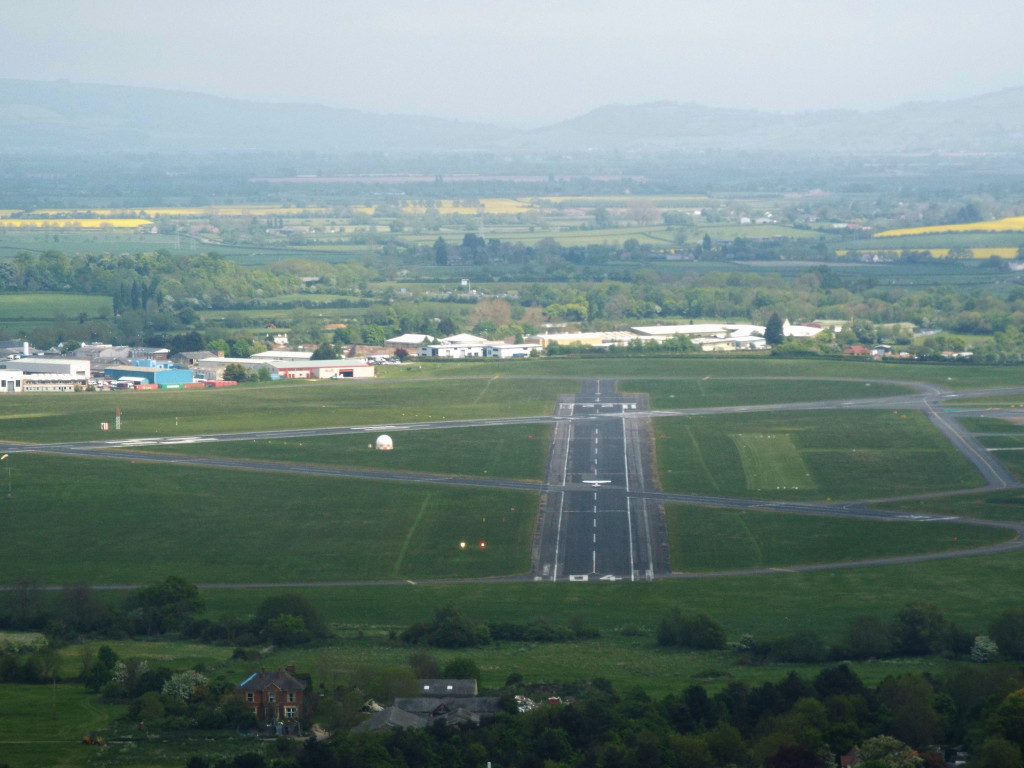
On final for Runway 04 at Gloucester
Also worthy of note is the airport’s Aviator Restaurant which accommodated us all on a busy Saturday lunchtime and served up some excellent food in clean and pleasant surroundings.
Suitably refreshed over lunch (not just ourselves but also Sanjiv’s gadgets’ batteries!) we all made ready for the return leg. On the way up Reds 1&2 in VB had requested and received a transit through Brize Norton’s overhead. Thinking this sounded like a Good Thing we in Fox-Alpha resolved to do the same, this time with Sanjiv handling the tricky flying part. It proved to be a good decision because Brize was very happy to accommodate us, and we had a fantastic unrestricted view of everything on the ground as we flew over. If ever you find yourself wondering where all your taxes go, a flight over the top of Brize is highly recommended! Lots of grey and expensive machinery down there: C-17s, Airbus A400Ms (I never realised we have so many!), and Voyagers (I never realised we had so many!), plus a smattering of C-130Js and other visiting types. Most impressive.

The busy apron at Brize Norton
From Brize it was a relatively routine flight back home, more or less retracing our steps once we’d funnelled in via Bovingdon, and, with conditions having improved since earlier in the day, some good views of London as we skirted around the M25.
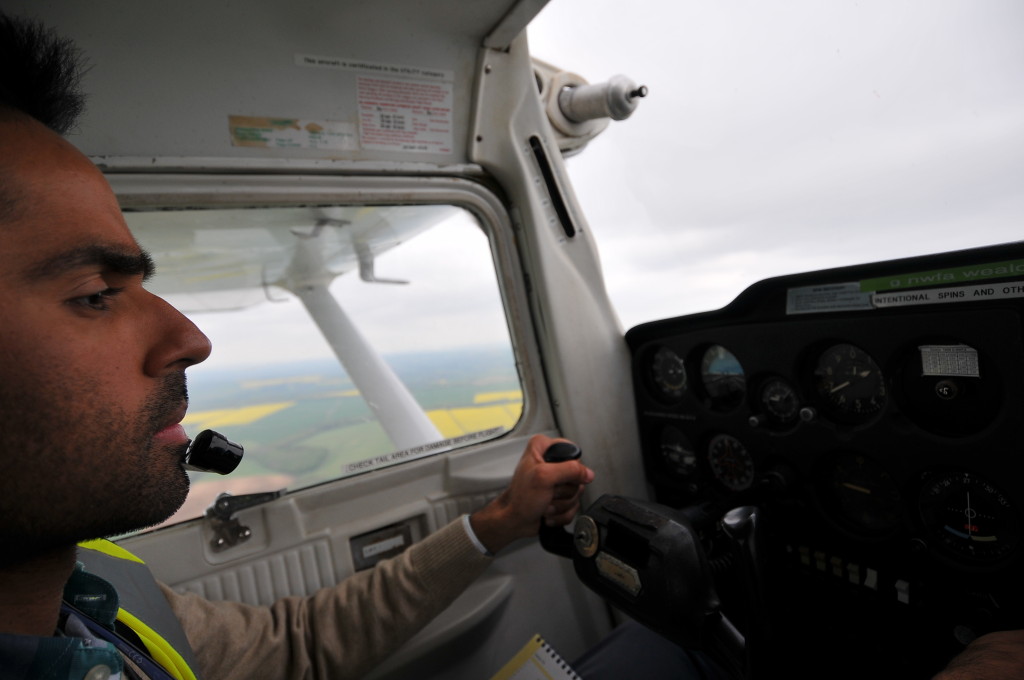
Sanjiv guides Fox-Alpha home
All in all a good day’s flying, and, despite not being the day we originally all had in mind (and that plan is not now dead, just ‘resting’), it was good simply to get together with other pilots and blow away some cobwebs.
My thanks as ever to all the crews who took part for helping make the day.


